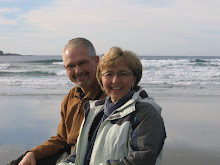
Wow, eh, there is so much going on, it's hard to find the time to sit down and write about it. On the weekend of May 28-30, Diane and I went to Vancouver Island and spent a couple of nights in Victoria. It all started with Diane finding out that Steve Bell was doing a concert in Victoria at Christ Church Cathedral. Well, when I went to Steve's website, I discovered that he was also providing music for a Brian McLaren seminar entitled "Evangelism and Transformation in a Secular Society." I have enjoyed some of McLaren's writings, especially The Secret Message of Jesus. So, I said to Diane, "Let's not just go for the concert, but for the weekend. You can relax at the hotel and enjoy downtown Victoria Friday evening and Saturday; I will take in the seminar during that time, and we'll both enjoy the concert Saturday evening." She liked the idea.
The concert was terrific - especially in that cavernous cathedral. I couldn't help but wonder how much it would cost to heat that place; I mean, to keep the people warm in the winter down at floor level when the heat would be rising to a ceiling that seemed half way to the sky.
Brian McLaren's seminar was also terrific. Some Christians feel that McLaren is going the wrong way. I like what David Csinos said in a recent edition of the Canadian Mennonite in an article called What to do with Postmodernism? - a response to McLaren's recent book A New Kind of Christianity. He says, "However, I think McLaren is on to something important. He realizes that the church must engage the cultures in which it finds itself." He also says, "This Christianity is not a new Christianity, but a revised version of Christianity we inherited and are refashioning in order to be faithful to the gospel and to Christ in the 21st century."
Here are a couple highlights from McLaren's seminar. He said that people are validated when they come into church to find out that our life out there has meaning. A central passage for the seminar was 1 Peter 3:15, "But in your hearts revere Christ as Lord. Always be prepared to give an answer to everyone who asks you to give the reason for the hope that you have. But do this with gentleness and respect." His emphasis from this verse is two-fold, that we should always be ready to talk about the hope that we have, and that we should always do it with gentleness and respect. This is our witness. He said to be honest, unedited, to stop the religious stuff and just be Christ-followers - that's what will convince people today of the Jesus way.
The last thing I'll say about the seminar is that McLaren encouraged us to look for the Third Track. This affirms that the Holy Spirit is at work in the world, preparing people long before we Christians show up. Then when we do show up and start to build friendships with people, they will speak into our lives and we will speak into theirs. Jesus is the Way, and his way will include all the work that God is doing - in the trained Christian and in the person we encounter out there. Both stories will inform the understandings of what God is doing, and as we align with this, a third way will form that is the Jesus way.
Much of what McLaren says has an Anabaptist ring to it. He also is quite free to recognize a strong appreciation for and influence from Anabaptist principles. Like I've been know to say, it's not that the Mennonite Church is going the emergent way, but that a lot of these postmodern theologians have become quite Anabaptist.
I have just finished reading Greg Boyd's book The Myth of the Christian Nation. Thanks to George Ediger from Kelowna First Mennonite Church for introducing me to this book. Boyd is thoroughly Anabaptist. His main point of reference is the state of the church in the United States. But, if we can see this as merely an illustration of a church that has succumbed to the temptation to embrace the powers of the kingdom of the world in order to hold power over others, we can easily apply the understandings in the book to the Canadian scene. The central theme of the book is that the Jesus way is to rather hold power under people, or to empower people, setting our needs aside for the sake of others.
Greg Boyd also does the Forward in the latest Stuart Murray book The Naked Anabaptist: the bare essentials of a radical faith. While the title is provocative, the essence of the book is powerful - that is, to strip away all the baggage that has often accompanied Mennonites, and rediscover the basic understandings of the Anabaptist way. This is my next book to read. Currently I am in the midst of Kingdom Culture: Growing the Missional Church, by Phil Wagler - a regular contributor in the Canadian Mennonite. I highly recommend Wagler's book as a tool for practical application of missional church principles.
I really see all these resources that I have recently encountered as signs of great hope for the church today.
Sunday, June 6, 2010

Saturday, May 15, 2010
Let's Ride Again


Riding the Duffey Lake Road was the popular consensus of the folks on the 2009 ride on the Island. Just in case you forgot what we did or what you missed, there were 6 of us who rode to Gold River one day and then up Mount Washington the next. Our home base was the United Mennonite Church in Black Creek. Check it out on my last year's blog entries.
Last summer, on a ride back from up north, I scouted out the Duffey Lake route. I had two concerns. One was that there was major bridge construction between Lillooet and Pemberton. Two was that to do the circle route back to the Lower Mainland would be a very long day.
Here are some of my thoughts from last summer. Title: MCBC Motorcycle Ride 2010 notes taken during and after scouting out the Duffey Lake Road.
1. The ride from the junction of highways 97 & 99 to Whistler took me 3:15. This included 2 stops, one to take off my chaps & kidney belt because it was too hot, the other for gas.
2. There were some amazing stretches of perfect road with nice twisties - most of the way from highway 97 to Lillooet and then again, starting about 1/2 way between Lillooet and Pemberton, most of the way to Pemberton. There were some pretty bad stretches of road, including some big construction projects - this was on the first ½ of the way from Lillooet to Pemberton, and the last stretch before Pemberton. There were a number of single lane bridges, and in many places the speed limit was down to 60. The possibility of getting behind a slow-moving vehicle for a period of time is real, and there were no places where a group could pass. I think it would be a lot of fun, it sure was for me by myself. I don't know what the cut off between Lillooet and Lytton is like, although someone told me it is a very nice stretch of road. The road from Pemberton to Whistler was a nice highway, although the maximum speed limit was 80.
3. The ride from Whistler to Vancouver (I checked time at Taylor Way and Marine Dr. in West Vancouver) took 1 1/2 hours. The new Sea to Sky Highway is amazing - you just pray for the guys on the crotch rockets riding on the edge of their lives at three times the speed limit. The breath-taking views go unseen for these guys.
4. The ride from this spot in West Vancouver, home to Ladner took 3/4 hour.
So I tried to figure out in what condition all the construction is at this time. I ended up emailing the Pemberton Chamber of Commerce to ask. Here is the response on April 4th, 2010, "Hello Garry. Last year saw the completion of two bridges on the Duffey Lake Road, - the large one at the slide area before entering the canyon before Lillooet and another smaller one just prior to the large bridge. There also was about 20 kms of the road re-paved from Pemberton to the Lake ( Duffey Lake). This year there are plans to do some more paving as well. The road is in the best condition it has ever been and of course is a very popular motorcycle route. Hope this bit of info helps you. Regards, Shirley Henry, Pemberton Chamber of Commerce.
I think I have concern number one resolved.
The number two concern is still unresolved. I checked a blog on this ride, and here is a comment on the time of the whole route, "He started The Duffey Loop at 11:00am in Langley, riding up the Fraser Canyon to Cache Creek, then into the Marble Canyon, to Lillooet, Pemberton, Whistler, Squamish and Vancouver, returning to Langley at 10:15pm for a total of 703 kilometres."
I don't know if this guy was on a cruiser or a rocket, but it took him 11 hours and 15 minutes. That's a long day. I'm sure there must be a place to stay in Lillooet for night. I guess if we gave options, some could make it a one day trip and others a two day. If some of you may be coming from Black Creek, it would possibly be a two night event.
If anybody new is reading this who is not on my MCBC Motorcycle Riders email list, and would like to do the ride, leave a comment.
I am thinking we would go the weekend of August 14-15. Give me your thoughts.
If you are interested in more photos of my ride, go to http://www.jonjanzen.com/2010/05/pops-and-his-ride.html. If you are interest in the photographer (free ad for my son), go to the same address and leave a comment that you would like him to take photos of your ride, with your contact information.

Tuesday, May 11, 2010
SAVED BY AN ANGEL
Last night I took in a moving talk by LEON LEYSON,the youngest survivor on “Schindler's List” entitled SAVED BY AN ANGEL. He shared his heart-wrenching story of life in the factory of Oscar Schindler. He was 13 at the time that he was taken into Schinldler's factory as his ticket of freedom from the death camp; he is now 80 years old.
At the centre of his talk was his continual reference to the "humanity" of Oscar Schindler. He spoke of the step-by-step dehumanisation of the Jewish people in his city of Krakow, Poland - from relegation to the back of public buses to Jewish ghettos in their own city, to concentration camps and death camps. Of all the German people (mostly Nazi soldiers) he met after the war began, Schindler was the only one who had life in his eyes - as opposed to the hollow emptiness he saw in all the others.
He spoke of his life's journey to freedom as being a series of fortunate events. In the question period, a woman of faith asked him if all this good luck that he spoke about was not the hand of God. He said that with all the pain and death around him and his family, and for all the other six million Jews that were exterminated, it was too presumptuous to suggest that God had this much favour on him over all these others. I too find it hard to presume that the series of fortunate events that has allowed us to live here in Canada is evidence of God's favour on us, while many believers around the world live in such tragic situations. Diane and I talked about this last night when I returned home, and we agreed that this is something we would like to ask God about in heaven.
There is so much that I could say about the talk. I will just conclude with Mr. Leyson's unhesitating answer to a young boy's question,"What has the world learned from the holocaust?" His answer, "Nothing."
At the centre of his talk was his continual reference to the "humanity" of Oscar Schindler. He spoke of the step-by-step dehumanisation of the Jewish people in his city of Krakow, Poland - from relegation to the back of public buses to Jewish ghettos in their own city, to concentration camps and death camps. Of all the German people (mostly Nazi soldiers) he met after the war began, Schindler was the only one who had life in his eyes - as opposed to the hollow emptiness he saw in all the others.
He spoke of his life's journey to freedom as being a series of fortunate events. In the question period, a woman of faith asked him if all this good luck that he spoke about was not the hand of God. He said that with all the pain and death around him and his family, and for all the other six million Jews that were exterminated, it was too presumptuous to suggest that God had this much favour on him over all these others. I too find it hard to presume that the series of fortunate events that has allowed us to live here in Canada is evidence of God's favour on us, while many believers around the world live in such tragic situations. Diane and I talked about this last night when I returned home, and we agreed that this is something we would like to ask God about in heaven.
There is so much that I could say about the talk. I will just conclude with Mr. Leyson's unhesitating answer to a young boy's question,"What has the world learned from the holocaust?" His answer, "Nothing."
Monday, April 19, 2010
MCBC's Big Day
Okay, I want to reflect on our MCBC Annual Meeting, but I have to try to draw you in with an exciting title!
It's hard to get everything done in one day - but who wants two days of meetings?! I found that I was constantly adjusting times of items on the agenda throughout the day because some of the items ended up taking more time than we had imagined or allotted. I was very blessed that at the end of the day we came out about where we had planned to - time-wise.
I found that the one item that we short-changed was the time for discussion. This was one item that could be moved around, but that it basically got moved right off the page was very disappointing for me. We are professing to be a church with a congregational approach, and then for the voices of the people to be squeezed out, suggests that we are not practicing what we preach. I just want to register that this was not our intention. It just happened due to the unexpected lengthening of the day.
I have heard many good responses, a couple of concerns, and some good ideas to consider for the future. The good responses were to the telling of the stories of the host congregations and the exciting welcome of our new congregation - the Western Hmong Mennonite Church.
One concern I recall is that the finance report should be more connected to the missional activity of MCBC. I have already mentioned this to our finance committee and they can appreciate this value, and will work towards it. A second concern is with the number of people who leave half way through the day, and then even more filter out through the afternoon. This has always been a concern, and so we ask for your ideas for a response to this matter. Thirdly, there was concern about the number of people who could not come to LEAD because it is during the day on Friday.
Here are some good ideas for the future. Some have said that my concern about lack of time for discussion was not a problem; they believed that there was not much to be discussed this year. But, they said that if there were some significant items for discussion, it doesn't make sense to have people just line up at mikes in the large assembly. We should bring well-articulated discussion items to table groups for some real interaction (as we have done in the past.) Some I spoke with felt that LEAD and the Annual Meeting could be both done on Saturday. Some said that the Annual Meeting should only focus on future vision, and not on the reports of the last year of activity (these are to be read in the report book.)
Well I hope this has given you some stimulation for your own responses. This time I SERIOUSLY WANT YOU WHO READ THIS BLOG TO RESPOND with your thought of how to best do LEAD and the Annual Meeting.
It's hard to get everything done in one day - but who wants two days of meetings?! I found that I was constantly adjusting times of items on the agenda throughout the day because some of the items ended up taking more time than we had imagined or allotted. I was very blessed that at the end of the day we came out about where we had planned to - time-wise.
I found that the one item that we short-changed was the time for discussion. This was one item that could be moved around, but that it basically got moved right off the page was very disappointing for me. We are professing to be a church with a congregational approach, and then for the voices of the people to be squeezed out, suggests that we are not practicing what we preach. I just want to register that this was not our intention. It just happened due to the unexpected lengthening of the day.
I have heard many good responses, a couple of concerns, and some good ideas to consider for the future. The good responses were to the telling of the stories of the host congregations and the exciting welcome of our new congregation - the Western Hmong Mennonite Church.
One concern I recall is that the finance report should be more connected to the missional activity of MCBC. I have already mentioned this to our finance committee and they can appreciate this value, and will work towards it. A second concern is with the number of people who leave half way through the day, and then even more filter out through the afternoon. This has always been a concern, and so we ask for your ideas for a response to this matter. Thirdly, there was concern about the number of people who could not come to LEAD because it is during the day on Friday.
Here are some good ideas for the future. Some have said that my concern about lack of time for discussion was not a problem; they believed that there was not much to be discussed this year. But, they said that if there were some significant items for discussion, it doesn't make sense to have people just line up at mikes in the large assembly. We should bring well-articulated discussion items to table groups for some real interaction (as we have done in the past.) Some I spoke with felt that LEAD and the Annual Meeting could be both done on Saturday. Some said that the Annual Meeting should only focus on future vision, and not on the reports of the last year of activity (these are to be read in the report book.)
Well I hope this has given you some stimulation for your own responses. This time I SERIOUSLY WANT YOU WHO READ THIS BLOG TO RESPOND with your thought of how to best do LEAD and the Annual Meeting.
Paddling for Squeah
This past weekend I spent two gorgeous days on the Fraser River in a canoe, paddling from Hope all the way to Fort Langley. I checked Google Maps for the distance by following the road distance on the No. 7 highway, which pretty much runs parallel to the river. It was 100 kms.
Each year the Paddle-a-Thon raises funds that are put towards the Camp Squeah Summer Staff Bursary Fund. This fund was established to help our volunteer staff who return to college or university after the summer, to still be able to spend their summers at camp and have something to put towards the ever rising costs of tuition. (This description is a quote directly from the camp website.)
I wasn't taking pictures, but there were lots of pictures taken, so hopefully I'll be about to get those for you later.
The VERY COOL thing was that in the end, we found out that a total of $51,000 was raised - with only 1/2 the paddlers of last year - 18 in all.
I was in a 2-person canoe with my friend, Gerald Dyck. The journey has us on the water Saturday morning and afternoon with a lunch break on a sand bar along the way. Then we camp for night at a spot north of Chilliwack. There is an amazing support crew that brings all our camping stuff and cooks supper for us. We just have to pitch our tents and go to bed.
Well, actually, the camp's Program Director (Tim Larson) has a friend living only 5 minutes from our camp site, and Tim invited anyone who was interested in watching the 2nd game of the Vancouver/Los Angeles Stanley Cup series, to join him. Who would turn down an invitation like that? It was a bit strange to go watch the game on a big screen in someone's nice house in the midst of our wilderness trip. Too bad the Canucks lost.
I have had some experience canoing in lakes, but river water is very different. Thankfully I got to take the front seat. Day One has the challenging water. On Day Two it's pretty wide open river - and I mean "wide". The Fraser takes up a lot of space at some places. On Day One (between Hope and Chilliwack), we had 4 or 5 narrow places with eddies and whirl pools that we had to carefully navigate, and then power through the rough waters in between. The calm before the rough water was a bit unnerving, but the calm after was rather comforting and satisfying. Gerald and I managed all the tough spots. In fact, of the one big canoe, the two 2-person canoes, and the four kayaks, only one kayak overturned once!
Day Two brought us to a lovely soup and sandwich lunch at a park just west of the Mission bridge, and then a pizza supper to close at Fort Langley.
It was amazing to take in the beautiful surroundings of nature. You see the back side of the mountains that are to the north of the No. 1 highway through the Fraser Valley. On day two we stopped for a mid-afternoon break on a beach along the way. When we got out of the canoes and looked back - at the centre of the view, framed by the mountains that rise up on either side of the river, was the beautiful snow-capped Mount Baker. It would have been to our backs all the time, but we didn't know.
Each year the Paddle-a-Thon raises funds that are put towards the Camp Squeah Summer Staff Bursary Fund. This fund was established to help our volunteer staff who return to college or university after the summer, to still be able to spend their summers at camp and have something to put towards the ever rising costs of tuition. (This description is a quote directly from the camp website.)
I wasn't taking pictures, but there were lots of pictures taken, so hopefully I'll be about to get those for you later.
The VERY COOL thing was that in the end, we found out that a total of $51,000 was raised - with only 1/2 the paddlers of last year - 18 in all.
I was in a 2-person canoe with my friend, Gerald Dyck. The journey has us on the water Saturday morning and afternoon with a lunch break on a sand bar along the way. Then we camp for night at a spot north of Chilliwack. There is an amazing support crew that brings all our camping stuff and cooks supper for us. We just have to pitch our tents and go to bed.
Well, actually, the camp's Program Director (Tim Larson) has a friend living only 5 minutes from our camp site, and Tim invited anyone who was interested in watching the 2nd game of the Vancouver/Los Angeles Stanley Cup series, to join him. Who would turn down an invitation like that? It was a bit strange to go watch the game on a big screen in someone's nice house in the midst of our wilderness trip. Too bad the Canucks lost.
I have had some experience canoing in lakes, but river water is very different. Thankfully I got to take the front seat. Day One has the challenging water. On Day Two it's pretty wide open river - and I mean "wide". The Fraser takes up a lot of space at some places. On Day One (between Hope and Chilliwack), we had 4 or 5 narrow places with eddies and whirl pools that we had to carefully navigate, and then power through the rough waters in between. The calm before the rough water was a bit unnerving, but the calm after was rather comforting and satisfying. Gerald and I managed all the tough spots. In fact, of the one big canoe, the two 2-person canoes, and the four kayaks, only one kayak overturned once!
Day Two brought us to a lovely soup and sandwich lunch at a park just west of the Mission bridge, and then a pizza supper to close at Fort Langley.
It was amazing to take in the beautiful surroundings of nature. You see the back side of the mountains that are to the north of the No. 1 highway through the Fraser Valley. On day two we stopped for a mid-afternoon break on a beach along the way. When we got out of the canoes and looked back - at the centre of the view, framed by the mountains that rise up on either side of the river, was the beautiful snow-capped Mount Baker. It would have been to our backs all the time, but we didn't know.
Monday, April 5, 2010
Having a Shower
Okay, this is not exactly about having a shower, but about fitness. As I have mentioned, I have the privilege of playing drop in hockey 3 mornings a week all year round (for free), playing on a team in hockey season, and roller blading when hockey doesn't work out and the streets are dry.
There are several reasons why I chose not to move to Abbotsford when I accepted the calling to be the Executive Minister for Mennonite Church BC. The most prominent one was the reality that the life of my family was in the Vancouver area. This included the fact that all three of our children were still living at home, Diane had a job within walking distance of our home, and we had no interest in changing churches.
Another reason I wanted to stay in the Vancouver area was to keep one foot in this area. The MCBC congregations are fairly evenly distributed between Metro Vancouver and the Fraser Valley. I knew I would be putting one foot firmly into Abbotsford and the Fraser Valley, but I still wanted to keep the other one where the other 1/2 of our congregations are.
Lastly, and the least known reason that I wanted to stay in Ladner, is that I had a very good fitness option here of playing drop in and team hockey. The early morning drop in hockey is my greatest place of Christian witness. There are at least 30 guys that come out regularly. They come from all walks of life. Some are Christians, but most are not. We have a bbq every summer. A bunch of us went out for sushi around Christmas.
When going to hockey doesn't work out, roller blading is a great option. Ladner is probably the flattest place in the Lower Mainland, so I have found some routes of nice smooth pavement. I don't know how it is in Abbotsford or elsewhere where you might be, but in Ladner (part of the Fraser River delta as it flows into the ocean), when the wind is blowing, it seems to blow from three different directions. When I am roller blading and it is windy (like today), I go some of the distance in all four directions. I know when the wind is at my back, but I certainly also know when it is not.
All this said, I really try to not have a shower unless I have completed one of the excersie options!
There are several reasons why I chose not to move to Abbotsford when I accepted the calling to be the Executive Minister for Mennonite Church BC. The most prominent one was the reality that the life of my family was in the Vancouver area. This included the fact that all three of our children were still living at home, Diane had a job within walking distance of our home, and we had no interest in changing churches.
Another reason I wanted to stay in the Vancouver area was to keep one foot in this area. The MCBC congregations are fairly evenly distributed between Metro Vancouver and the Fraser Valley. I knew I would be putting one foot firmly into Abbotsford and the Fraser Valley, but I still wanted to keep the other one where the other 1/2 of our congregations are.
Lastly, and the least known reason that I wanted to stay in Ladner, is that I had a very good fitness option here of playing drop in and team hockey. The early morning drop in hockey is my greatest place of Christian witness. There are at least 30 guys that come out regularly. They come from all walks of life. Some are Christians, but most are not. We have a bbq every summer. A bunch of us went out for sushi around Christmas.
When going to hockey doesn't work out, roller blading is a great option. Ladner is probably the flattest place in the Lower Mainland, so I have found some routes of nice smooth pavement. I don't know how it is in Abbotsford or elsewhere where you might be, but in Ladner (part of the Fraser River delta as it flows into the ocean), when the wind is blowing, it seems to blow from three different directions. When I am roller blading and it is windy (like today), I go some of the distance in all four directions. I know when the wind is at my back, but I certainly also know when it is not.
All this said, I really try to not have a shower unless I have completed one of the excersie options!
Searching for Pastors
A big part of my work life is helping congregations search well when they are needing a new pastor. Right now we have five searches going on and a couple of others who are considering it. Eden Mennonite Church in Chilliwack is looking for a associate pastor with primary responsibility towards the youth; Sherbrooke Mennonite Church in Vancouver is looking for an associate with responsibility for youth and young adults (and possibility worship if the right person is found); Chinese Grace Mennonite Church in Vancouver looking for a youth/English pastor; United Mennonite Church, Black Creek (on Vancouver Island) is looking for a lead pastor; and Kelowna First Mennonite Church is also looking for a lead pastor.
The value of getting a good fit in a pastor/congregation relationship is immense, and sets the stage for a good journey together. This is why MCBC is giving a significant effort toward helping congregations search well. I have put a lot of miles on in meeting with search committees, and I am more than willing to continue to make this a number one priority.
If there is a transition happening that we don't know about, please let us know so that we can help you get at the best resources to do a good search and find a good fit.
Another part of a good journey together is having a Pastor Congregation Relations Committee. This should not be the church board or any other committee in the structures of congregational leadership. It is a neutral committee that is a liaison between the congregation and pastor. These committee members are available to hear the pastor's concerns, as well as the congregation's concerns. They are also there to make sure regular encouragement is passed on. They stand in the gap to help the relationship to be strong, open and healthy.
Please call me at any time. You can also get very helpful resources at the Mennonite Church Canada website, www.mennonitechurch.ca. Go to the Resource Centre and then type in a search for Ministry Transitions. There will be documents to download on all of these matters.
The value of getting a good fit in a pastor/congregation relationship is immense, and sets the stage for a good journey together. This is why MCBC is giving a significant effort toward helping congregations search well. I have put a lot of miles on in meeting with search committees, and I am more than willing to continue to make this a number one priority.
If there is a transition happening that we don't know about, please let us know so that we can help you get at the best resources to do a good search and find a good fit.
Another part of a good journey together is having a Pastor Congregation Relations Committee. This should not be the church board or any other committee in the structures of congregational leadership. It is a neutral committee that is a liaison between the congregation and pastor. These committee members are available to hear the pastor's concerns, as well as the congregation's concerns. They are also there to make sure regular encouragement is passed on. They stand in the gap to help the relationship to be strong, open and healthy.
Please call me at any time. You can also get very helpful resources at the Mennonite Church Canada website, www.mennonitechurch.ca. Go to the Resource Centre and then type in a search for Ministry Transitions. There will be documents to download on all of these matters.
Subscribe to:
Posts (Atom)